
Beyond Self-Care:Building Co-Regulated Communities
Why Your Nervous System Needs Others (And Why Systems That Prevent This Are Themselves Harmful)
by Michele Renee, DC, MAc
Person alone, looking out the window on a dreary day overlooking a city.
The Myth of Self-Care
Somewhere along the way, most of us learn that healing is individual. According to the Pew Research Center, the average household size is 2.5, significantly lower than the global average of 4.9. We champion independence, strength, going it alone. We prize productivity, pushing through, and overcoming. But where does that leave us when we need to heal something deep? Or when we experience a significant illness?
The wellness industry capitalizes on this isolation. Self-care has become a multi-billion dollar industry built on the premise that wellness is something you purchase and practice alone. A luxury. Something you do for yourself—bubble baths, meditation apps, wellness retreats. Individual solutions to systemic problems.
But here’s what neuroscience tells us: you are not wired to change alone.
Your nervous system doesn’t work in isolation. It synchronizes with the nervous systems around you. Your habits—what you eat, how you move, how you rest—are shaped not by your willpower but by the people you live with. If everyone around you eats fast food, your brain is literally neurologically primed to do the same. If your family is sedentary, your body adapts to that rhythm. We absorb the habits of those we’re close to through mirror neurons, the biological mechanism that makes us reflect what we see.
Yet we’re told our health is our individual responsibility. So you try to eat differently than your family. You exercise alone. You meditate while everyone else scrolls. You sustain this for a while through sheer willpower, and then you burn out. Because you’re swimming against the current of every person in your household.
This is wrong. And it may even be traumatic.
The paradigm of individualistic self-care means managing your own nervous system alone. That asking for support is weakness. That the goal is to become so self-regulated that you never need anyone else. That if you’re struggling, it’s because you’re not doing enough self-care.
Your nervous system is not designed for solitude. It’s designed for co-regulation—the biological process where your nervous system learns safety by being in relationship with other regulated nervous systems.
Real self-care isn’t what you do alone. It’s what we build together.
It’s not something you do after you’re “fixed.” It’s foundational. It’s infrastructure. It’s tending.
And if you’re living in a system that isolates you, pathologizes your need for connection, or punishes interdependence, that system itself is creating the trauma you’re then expected to heal from alone—through self-care.
Four people sitting in a grassy field facing away, forming hearts with hands
What Co-Regulation Actually Is (The Neuroscience)
Co-regulation is when your nervous system’s threat detection system learns to stand down because it’s detecting safety in another person’s nervous system.
This happens through:
Neuroception
Your body is constantly scanning the environment for safety and danger—faster than conscious thought. When you’re in the presence of another person whose nervous system is regulated, your brain detects this. The unmyelinated vagal fibers in their face, voice, and body posture signal: You are safe.
Your nervous system doesn’t have to do all the work alone. It can borrow the safety from theirs.
Polyvagal Regulation
The vagus nerve connects your brain to your heart, lungs, and gut. When you’re dysregulated—stuck in fight, flight, freeze, or collapse—your vagus nerve is locked in protective mode. Another regulated person’s presence can activate your ventral vagal pathway, the system responsible for social engagement and calm.
This is why sitting with a calm person helps you feel calmer. It’s not willpower. It’s not positive thinking. It’s not another self-care hack you need to master. It’s neurobiology.
Mirror Neurons: How We Learn (and Sustain) Our Habits
Your brain contains mirror neurons—cells that fire both when you perform an action and when you watch someone else perform it. This is how you learn. It’s how your body absorbs the habits of those around you without conscious effort.
This is why lifestyle medicine works—or fails—based on your environment. If the people you live with eat well, move regularly, and manage stress collectively, your nervous system is primed to do the same. Your body is literally synchronizing with theirs. You don’t have to choose wellness alone; you’re embedded in a system where wellness is normal.
But if everyone around you is eating processed food, sedentary, stressed, and isolated, your mirror neurons are working overtime to synchronize you with that reality. Your willpower becomes exhausted fighting your own neurobiology.
This is why trying to change your diet alone—eating different meals than your family—is so hard. You’re not just changing your behavior; you’re working against the neurological pull of everyone around you.
Intergenerational Transmission
Here’s where it gets both darker and more hopeful: your nervous system’s baseline regulation was shaped by co-regulation (or the lack of it) with your caregivers. If you grew up with dysregulated, traumatized, or absent caregivers, your nervous system learned to stay activated. It learned that the world wasn’t safe enough to relax into. This is intergenerational trauma.
But here’s the hope: nervous systems can be retrained. Intergenerational trauma—passed down through dysregulated caregivers—can become intergenerational healing when you’re in relationship with people whose nervous systems have learned safety.
We Didn’t Evolve to Do This Alone: The Evolutionary Reality
Here’s what’s important to understand: you are not wired for independence. You are wired for community. And that’s not a personal preference or a weakness—that’s 300,000 years of human evolution.
For the vast majority of human history, we lived in small tribes. Groups of 25–150 people where survival depended on knowing each other’s nervous systems, on learning by watching, on coordinating our responses to threat. Our brains developed mirror neurons because we learn from each other. Our attachment systems evolved because children whose caregivers were attuned to them survived. Our stress response systems developed in the context of the group—we’re supposed to regulate together.
This is not metaphorical. Your nervous system was shaped by evolution to be in relationship. Co-regulation isn’t a nice-to-have. It’s foundational to how humans are designed to live.
The last 200 years of industrialization? The last 80 years of nuclear families? The last 40 years of the “independence as strength” narrative? That’s a blip in evolutionary time. Your body hasn’t adapted to isolation. Your nervous system experiences it as what it actually is: a death sentence.
For humans throughout history, isolation meant you were exiled from the tribe. It meant you wouldn’t survive. Your body knows this at a cellular level. When you’re isolated, your nervous system stays activated—always scanning for threat—because, evolutionarily speaking, you are in danger. Alone, you die.
This reframes everything about what you’re experiencing:
You’re not broken for needing co-regulation. The system that isolates you is broken.
Children developing in isolation (whether that’s emotional isolation, physical isolation, or the “independence training” we do in the name of resilience) are experiencing evolutionary deprivation. They’re being denied the relational context humans need to develop a regulated, healthy nervous system.
Collective trauma happens when you sever humans from their evolutionary context. It’s what happens when you tell a social species to survive alone. It’s violence.
The fact that you burn out trying to sustain health changes by yourself? That’s not a personal failing. That’s your nervous system telling you the truth: you can’t do this alone. Your mirror neurons are pulling you toward the habits of your community because that’s how you’re designed to survive. Your body is right.
The good news: returning to connection isn’t a luxury upgrade to your wellness routine. It’s a return to how humans are actually supposed to live. And your nervous system will feel the difference immediately.

Fireworks on the night sky, symbolizing independence
Why Systems Block Co-Regulation (And Call It “Independence”)
We live in a culture that pathologizes the need for co-regulation. We call it “codependency.” We celebrate the person who “doesn’t need anyone.” We frame interdependence as weakness.
Meanwhile, we’ve created systems—work, healthcare, education, justice—that actively prevent the very co-regulation humans need to heal:
Isolation as a Feature of Trauma
Violence, oppression, and systemic harm all rely on isolation. They separate you from community. They make you believe your suffering is individual, not collective. They convince you that you’re uniquely broken.
Collective trauma—the shared nervous system dysregulation of communities experiencing systemic violence, oppression, or injustice—is then treated as if it’s an individual mental health problem. We pathologize post-traumatic stress disorder while ignoring that post-traumatic thriving is only possible when communities heal together.
The Failure of Solo Health Changes
We tell people: “You need to eat better. You need to exercise more. You need to manage stress.” And then we tell them to do these things alone. You make yourself a different meal than your family. You exercise while everyone else watches TV. You meditate while your household operates in chaos around you.
This doesn’t work. Not because you lack willpower, but because you’re working against the neurological pull of your environment. Your mirror neurons are synchronizing you with the habits of the people you live with. You can fight this for a while, but it’s exhausting. Eventually, you give up.
Real health change happens when the people in your life change with you. When your family decides together to cook differently. When everyone moves together. When rest becomes a household value, not just your personal practice.
Restorative Justice vs. Punishment
The criminal justice system is built on isolation: solitary confinement, incarceration, separation from community. It creates more trauma, not less. It prevents co-regulation.
Restorative justice, by contrast, recognizes that healing requires being in authentic relationship with harm—with the person you harmed, with your community, with witnesses. It’s built on co-regulation.
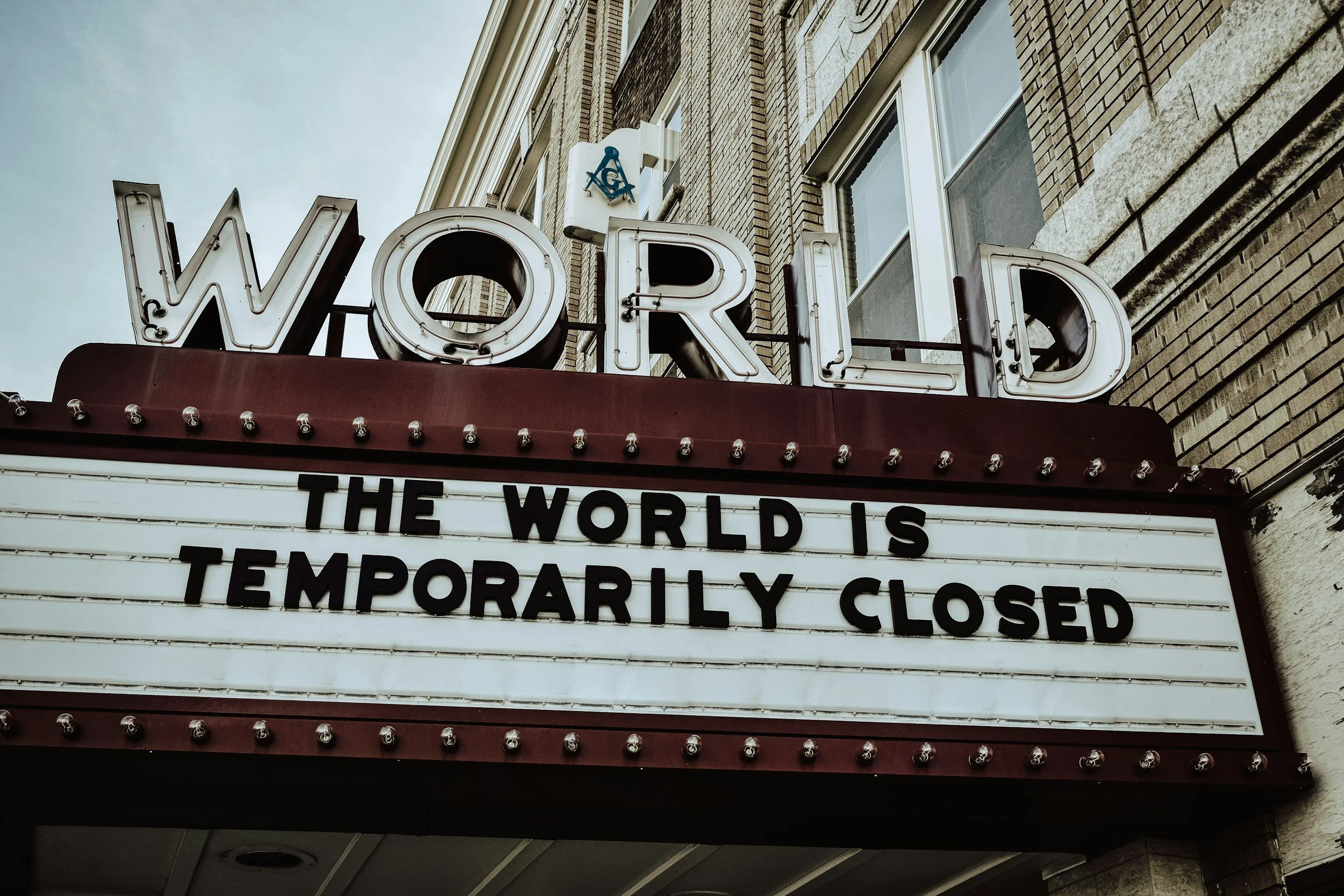
Marquis reading “the world is temporarily closed”.
The COVID Isolation Experiment: What Was Sold As Temporary Became Structural
In 2020, we conducted an accidental mass experiment in isolation. It was supposed to be temporary. Two weeks to flatten the curve became two years. And then, quietly, isolation stopped being an emergency measure and became the default.
Remote work—sold as a temporary pandemic necessity—is now a permanent feature of work life for millions. No more office. No more casual hallway conversations, lunch with colleagues, the incidental co-regulation that happens in shared physical space. We’re told it’s efficient, it’s flexible, it’s better work-life balance. What we’re not told is that we’ve eliminated a major source of daily co-regulation for anyone whose job allows it.
Meanwhile, vulnerable populations never got to stop isolating. High-risk people continued masking, continued avoiding gatherings, continued experiencing the nervous system dysregulation of chronic isolation. They watched the world “reopen” while they remained exiled. Their nervous systems stayed activated. Not out of weakness, but out of legitimate threat detection.
But here’s the catastrophe we’re not talking about: Long COVID.
An estimated 8 to 10 million Americans currently have Long COVID, with 21 million having experienced it at some point. That’s not a small number. That’s roughly equivalent to the entire Alzheimer’s disease population—except it is invisible, unsupported, and largely abandoned by the systems that should be helping.
Long COVID is a multi-system disease. For some, it’s post-exertional malaise that means even mild activity triggers crashes that can last days or weeks. For others, it’s cognitive dysfunction (brain fog so severe work becomes impossible), or dysautonomia, or the kind of fatigue where getting out of bed is a monumental task. There is no cure. There is no timeline for recovery. It simply persists.
And here’s what we’re not acknowledging: Long COVID patients are isolated twice over.
First, by the illness itself. You can’t go to work. You can’t participate in family gatherings if they’re too stimulating. You can’t be in loud, crowded spaces. The very activities that would provide co-regulation—movement, community, connection—are either impossible or will trigger a crash that leaves you bedridden for days.
Second, by a society that has moved on. We stopped talking about COVID. We stopped protecting vulnerable people. We went back to “normal.” And Long COVID patients, many of whom live alone, were left behind. No co-regulated workspaces (remote work is isolation, remember). No communities showing up for them, in many cases. No structured support. Just the profound, neurologically devastating isolation of chronic illness in a society that has decided the pandemic is over.
Monkey see, monkey do. That’s what mirror neurons do. And during 2020–2024, what did our children see? They saw adults isolating. They saw fear of proximity. They saw connection as dangerous. They saw their parents—the regulated nervous systems they depend on—dysregulated and scared. They learned that separation is safety. They learned to fear the bodies of others.
We missed key developmental windows for in-person socialization, peer bonding, learning how to regulate in groups. Gen Z spent critical years of social development learning isolation and fear. Their mirror neurons absorbed a completely different set of “normal” behaviors than any generation before them. And now we’re shocked that young people struggle with communication, with being in groups, with sustaining relationships in person.
Long COVID is the clearest evidence we have that isolation is violence.
8 to 10 million people removed from workplaces, from family gatherings, from the casual co-regulation of daily life. Many of them living alone. Many of them disabled by a system that told them it was temporary, then abandoned them when the pandemic became inconvenient. Their nervous systems are dysregulated not because they’re broken, but because they’ve been systematically isolated by both illness and systemic neglect.
And we’ve normalized it. We’ve moved on. We’ve built a work culture around remote isolation. We’ve left vulnerable populations to fend for themselves. We’ve let an entire generation learn that connection is dangerous.
This is the system blocking co-regulation. Not just historically, but right now. Today.
Lavender CBD bath bomb with essential oil
Capitalism’s War on Interdependence (And the Commodification of Self-Care)
Late-stage capitalism requires you to be isolated consumers. It needs you dysregulated enough to keep buying things that promise (but never deliver) peace.
This is where self-care becomes dangerous. The wellness industry has weaponized self-care to make isolation profitable. They’ve taken a concept that could mean collective care and repackaged it as individual consumption. You’re anxious? Buy this meditation app. You’re burned out? Buy this wellness retreat. You’re struggling with your health? Buy this supplement, this program, this tracking device.
Self-care became another way to tell you that your suffering is your responsibility to fix. Alone.
The system profits from you believing that healing is a product you can buy alone, not a process that requires community. It benefits from you being too exhausted from individual wellness practices to build collective power.
Interdependence? Mutual aid? Community care? These threaten profit.
Your Body’s Response to Collective Trauma Is Not Pathology
Right now, many nervous systems are activated.
If you’re witnessing state violence, systemic injustice, or the brutalization of your community—your nervous system responding with hypervigilance, rage, or dissociation is not post-traumatic stress disorder in the pathological sense. It’s an appropriate response to real threat.
And here’s what trauma-informed care should tell you: You don’t heal from this alone.
Collective Trauma Requires Collective Healing
When communities experience shared threat, individual self-regulation is not enough. You need co-regulation with others who understand, who are in it with you, who can help regulate your nervous system back toward safety.
This is why community, movement, organizing, and togetherness are healing practices. They’re not separate from mental health. They ARE the mental health intervention. They’re the real self-care.
When you march with others, chant with others, sing with others, sit with others in grief—your nervous system is being co-regulated. Your body is detecting: I am not alone in this. We are doing this together. There is safety in solidarity.
What Post-Traumatic Thriving Actually Looks Like
Post-traumatic stress disorder focuses on the pathological outcome of trauma. Having a name for what people are experiencing is useful. It helps us define it, describe it, and in some ways, validate a complicated experience.
But what if we reframed it?
Post-Traumatic Thriving
The capacity to not just survive collective trauma, but to grow, to connect, to build liberation alongside others who’ve also been harmed.
Think of the mothers who lost children to gun violence and built Moms Demand Action—not despite their grief, but through it. Think of the AIDS activists of the 1980s who, abandoned by government and medicine, created their own care networks, their own research demands, their own funerals. Think of the women who survived workplace harassment and instead of retreating into silence, found each other and built the infrastructure for #MeToo. Think of Indigenous communities who’ve experienced genocide and forced erasure, and who are now leading language revitalization programs so their grandchildren can dream in their ancestral tongue.
Post-traumatic thriving doesn’t look like having recovered from what happened. It looks like being changed by it—and choosing to build something with those who were changed alongside you.
This requires:
Co-Regulated Communities
Not individuals who’ve managed to self-regulate despite isolation, but people in authentic relationship with each other, helping regulate each other’s nervous systems through presence, witness, and solidarity.
This looks like the grief group that has been meeting every Tuesday for four years—long past anyone telling them they “should be over it by now”—where people who’ve lost children sit with people who’ve just lost spouses, and the ones further out offer their nervous systems as a kind of proof that it becomes survivable. It looks like the veterans who get together not to talk about the war, but to work on cars or hunt or cook, because side-by-side co-regulation often doesn’t need words. It looks like the chronic illness community on a forum at 2am, where someone says I’m crashing again and I’m scared and three people who know exactly what that means show up in the thread within minutes. It looks like the neighbor who, after the factory closed and the neighborhood emptied, started a Wednesday potluck that turned into a block association that turned into a community land trust.
Co-regulated communities don’t require a therapist in the room. They require people who have decided to keep showing up for each other.
Restorative Processes
When harm happens (and it does), the path to healing isn’t punishment or isolation. It’s accountability, repair, and restoration of relationship.
This looks like the school that, instead of suspending the kid who threw the chair, convened a circle with the student, the teacher who was frightened, the family, and a trained facilitator—and spent two hours asking: What happened? What were you carrying? What do you need? What does repair look like? And the kid who threw the chair learned, maybe for the first time, that he could be held accountable without being thrown away. This looks like the faith community where a leader caused harm, and instead of quietly removing them and pretending it didn’t happen, the congregation held a series of structured conversations—painful, slow, non-linear—that allowed people to speak what they’d experienced and watch the person who hurt them actually reckon with it. It looks like the couple in therapy who learns to repair after a rupture by naming what happened, by turning toward instead of away, by making a bid for reconnection even when it’s humiliating—and discovering that the repair is sometimes more bonding than the conflict was damaging.
Restorative processes are slow. They ask more of everyone than punishment does. And they are the only processes that actually close the wound rather than just cover it.
Intergenerational Healing
Breaking the cycles of trauma that were passed down. Teaching your children (biological or chosen) what safety feels like in their nervous system because you’re offering it. This is how intergenerational trauma becomes intergenerational healing.
This looks like the father who grew up in a house where no one talked about feelings—where crying was weakness and need was punished—sitting on the edge of his daughter’s bed and saying, I don’t really know how to do this, but tell me what’s going on. It’s imperfect and halting and it is everything. It looks like the grandmother who survived a war, who spent decades unable to let anyone in, who at 74 starts going to a grief group because her granddaughter asked her to, and who comes home different—softer, somehow—and the granddaughter feels it before she can name it. It looks like the adoptive parent who learns, because their child is teaching them, what it means to have a nervous system that was wired in chaos—and who, instead of demanding the child perform normalcy, reorganizes the whole household around co-regulation. Slower mornings. More predictability. More repair after rupture, and less pretending the rupture didn’t happen.
Intergenerational healing doesn’t require you to have resolved your own trauma before you start. It requires you to be honest about it—to stop hiding it, stop performing wellness, and instead let the people who depend on you see that you are also learning what safety feels like. That’s not failure. That’s the transmission.
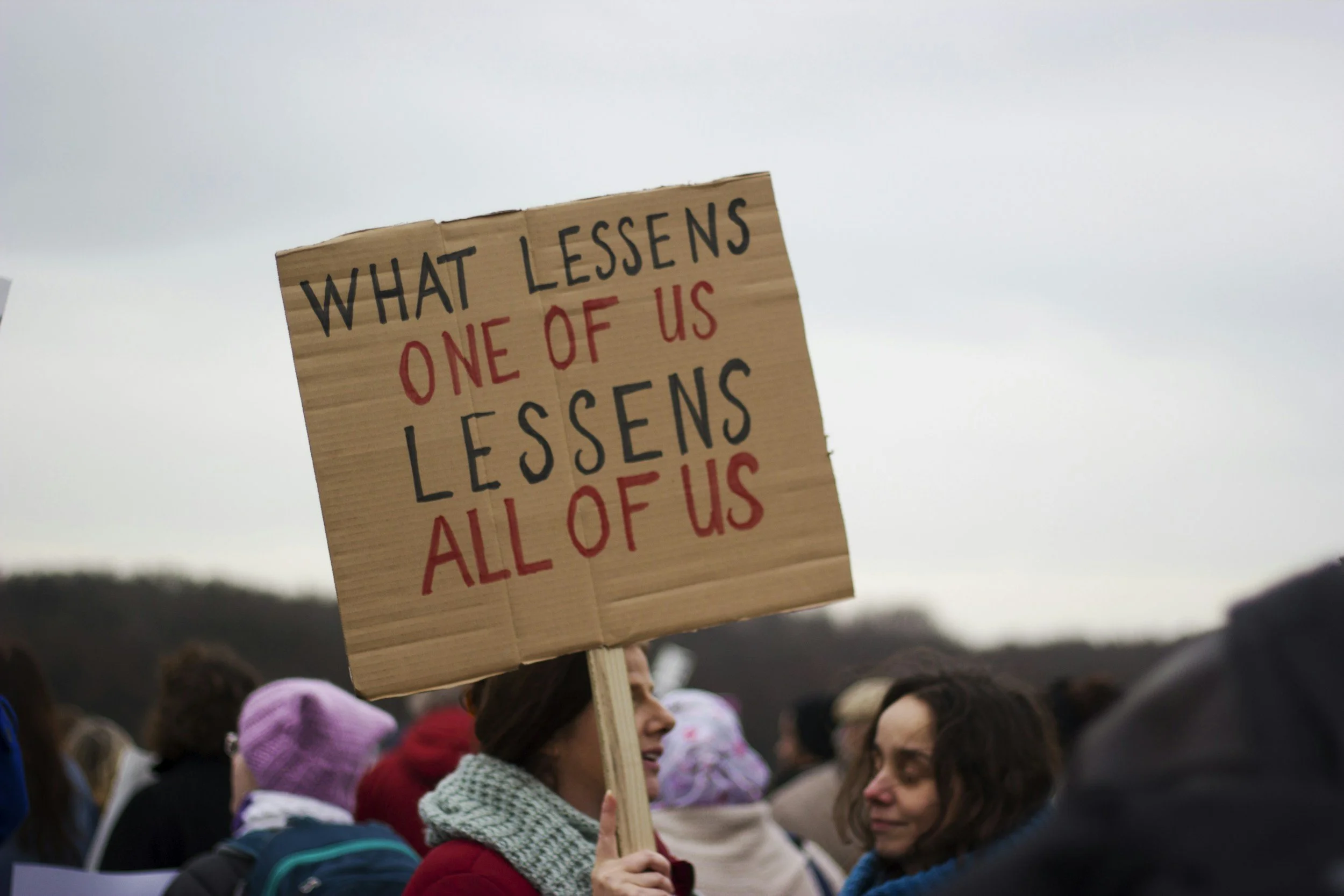
Women holding picket sign reading “what lessens one of us lessens all of us”, depicting the collective action as collective care.
Co-Regulation Is Political
Let me be clear: the ability to have co-regulated relationships is not equally distributed.
If you’re isolated by poverty, disability, incarceration, abusive relationships, or systems designed to keep you alone, you don’t have equal access to co-regulation.
If you’re a single parent, you likely don’t have access to co-regulation. In the US, 25% of households are run by single parents. Government supports for families and single parents can significantly impact parental access to co-regulation, but we can’t just rely on that.
This is not a personal failing. It’s structural violence.
Trauma-informed care that ignores this is incomplete. It’s telling someone to regulate their nervous system while the system that isolated them remains unchanged. It’s prescribing self-care to someone who doesn’t have access to the infrastructure that makes wellness possible.
Real Collective Care Includes:
Creating spaces where co-regulation is possible isn’t an amenity—it’s a necessity. Community centers, healing circles, mutual aid networks, family-friendly gathering places: these are not extras. They are the infrastructure of human health. When we defund community spaces, when we design cities without third places, when we build neighborhoods without front porches and parks and places to linger, we are making people sick. Rebuilding these spaces is a public health intervention.
Recognizing that solitary confinement is torture. That medical isolation can be traumatic. That poverty-induced isolation is violence. These are not metaphors. They are neurological facts. Any system that uses isolation as a tool—for punishment, for convenience, for containment—is causing measurable harm to the human nervous system. Naming this clearly is the beginning of changing it.
Building restorative justice practices that heal through relationship, not punishment through isolation. When someone causes harm, exile deepens the wound on all sides. Accountability that includes repair, witness, and the restoration of relationship is not softness. It is the only thing that actually works.
Centering collective healing in all trauma work. Not just teaching individuals to self-regulate, but building communities where regulation is mutual and ongoing. Every trauma-informed program, every healing modality, every mental health intervention should ask: What is the community context? Who is this person embedded with? How do we support the relational ecology, not just the individual?
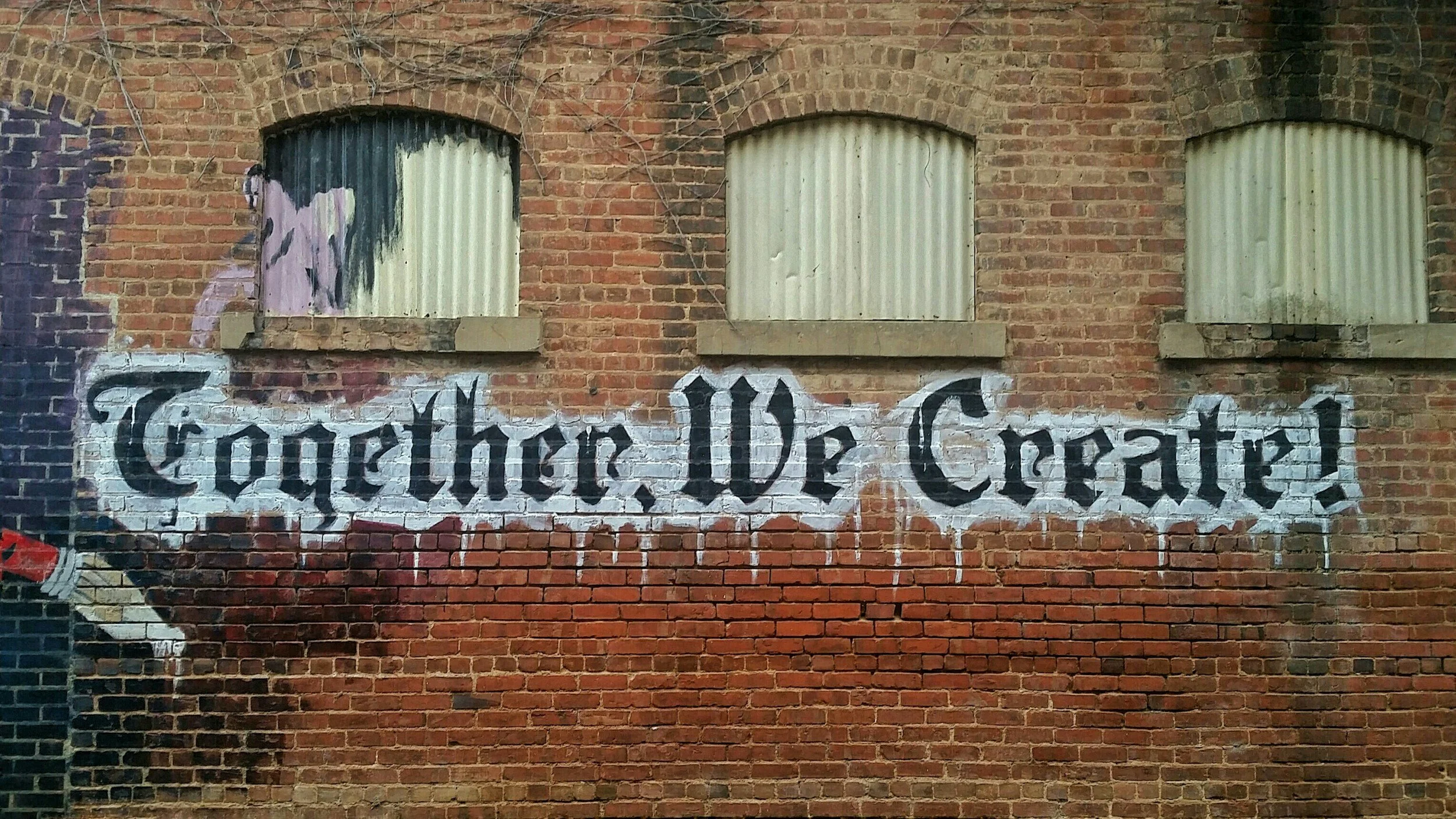
Mural on a brick wall ready “Together, We Create!”
Building Co-Regulated Communities: What Collective Care Looks Like
Real self-care starts here. Not with what you do alone, but with what we build together.
1. Stop Believing You Have to Change Alone
Reach out to the people in your life—your household, your family, your community. Don’t eat differently than everyone else. Don’t exercise alone. Don’t white-knuckle your way through health changes while everyone around you lives the old way.
Invite them in. Say: I need to make some changes for my health. Will you do this with me? Cook meals together that nourish everyone. Move together. Make the changes collaborative, not isolating.
This is not weakness. This is neurobiology. Your mirror neurons are designed to synchronize with others. Use that design. And understand that when you bring others with you into change, you are offering them something too—you’re creating an environment where their nervous system can also learn something new.
2. Find or Create Co-Regulated Spaces
Whether it’s a healing circle, a political meeting, a grief group, a movement space—find people who are also activated, also grieving, also fighting for change. Let your nervous systems regulate together. The act of being in a room with others who are naming what’s true is itself a nervous system intervention.
Create spaces where families can change together—where people cook together, move together, build health together. Where wellness is not a luxury you pursue alone, but a collective practice. Where children see adults taking care of themselves and each other, and learn that this is what normal looks like.
3. Practice Restorative Approaches
When harm happens—in relationships, in communities, in movements—the instinct is often punishment or withdrawal. Someone hurts you and you distance. Someone disappoints the group and they’re exiled. This re-creates the isolation that caused harm in the first place.
Restorative approaches ask a harder and more healing question: How do we repair this together? How do we restore relationship? This is how healing actually happens—not through the removal of the person who caused harm, but through accountability, repair, and the return to connection. It requires more of everyone. It also offers more to everyone.
4. Build Mutual Aid
Care for each other’s nervous systems. Help regulate each other. Share meals that nourish everyone. Move together. Check in. Show up. This is infrastructure. This is survival. This is freedom.
And build mutual aid that is actually mutual. The goal is a web of care, not a pyramid of it—which brings us to one of the most important and most overlooked truths about collective healing.
5. Give and Receive: Why Mutual Aid Must Be Mutual
Here’s something the wellness and social justice worlds often get wrong about mutual aid: it only works if it actually goes both ways.
One-directional helping isn’t mutual aid. It’s charity. It’s saviorism. And your nervous system knows the difference.
When you give without receiving—when you pour into others from a place of depletion, when you help because you’re afraid of being a burden yourself, when you take on the role of the regulated one who stabilizes everyone else—you are not in co-regulation. You are performing it. And you will burn out. Not because you’re not committed enough, but because your nervous system is being asked to do something it cannot sustain: regulate others while receiving no regulation in return.
Burnout is what happens when the nervous system runs on empty for too long. First comes the exhaustion, then the resentment, then the withdrawal. You pull back. You isolate. You stop showing up because showing up has become synonymous with depletion. The same person who was once a steady presence for others becomes, through no personal failing, unavailable—to their community, and often to themselves.
And here’s the thing no one talks about: chronic, high-load caregiving without adequate co-regulation and reciprocity is itself a pathway to chronic illness. The sustained stress of being a one-way channel—for emotional support, for crisis intervention, for holding community—dysregulates your autonomic nervous system over time. Your vagus nerve, chronically in output mode without input, can’t maintain the parasympathetic tone that keeps your immune, cardiovascular, and digestive systems regulated. The body keeps the score, and the score eventually shows up as autoimmune conditions, chronic fatigue, inflammatory illness, or all three.
This is not metaphorical. This is physiology.
The helper role can become its own kind of isolation. If you’re always the regulated one—the calm center, the strong friend, the healer, the organizer—you’ve created a relational structure that prevents you from being seen in your need. You’ve put yourself outside the circle of care you’re working so hard to build. And your nervous system experiences that as what it is: aloneness, even in the middle of a crowd.
Real mutual aid dismantles hierarchy, including the hierarchy between giver and receiver. It asks you to be both, fluidly, across time. To let yourself be seen in your struggle. To receive help without framing it as failure. To trust that being the one who needs something right now doesn’t disqualify you from also being the one who gives something later.
This is harder than it sounds, particularly for people who’ve survived by being self-sufficient, or whose worth was contingent on their usefulness, or who’ve absorbed the cultural message that needing anything is weakness. The impulse to give while refusing to receive is often trauma. It’s the nervous system’s learned strategy for staying safe in relationships that weren’t safe enough to be vulnerable in.
Healing that strategy is part of building co-regulated communities. You can’t build them as a one-way valve.
Practical questions to sit with:
Who do I let see me when I’m struggling?
Am I in any relationships where I am genuinely received, not just relied upon?
When someone offers me help, what happens in my body?
What would it mean to need something from my community—and ask for it?
Your nervous system cannot regulate others indefinitely without being regulated in return. Mutual aid works because it is mutual. Because your wellbeing is included in the circle of care. Because the community holds you too.
If it doesn’t, you’ll eventually have to leave the circle—not out of selfishness, but because your body will demand it.
The goal is not martyrdom. The goal is sustainability. The goal is a community where everyone, including you, gets to be human.
6. Pass It Forward: Intergenerational Healing
If you’ve experienced intergenerational trauma, healing it doesn’t mean doing wellness alone and hoping your kids pick it up. It means showing them what health looks like in real time, in relationship.
Your children learn what wellness means by watching what you do, not by hearing what you say. They learn whether rest is valued by watching how you rest. They learn whether nourishment matters by watching how you eat. They learn whether it’s okay to need people by watching whether you let yourself need people.
When you change alone, they learn that health is isolation—something you manage privately, something that separates you from others. When you change with your family and community, they learn that health is relational. That taking care of yourself is not a solo project. That needing others is not weakness.
This is how intergenerational trauma becomes intergenerational healing. Not through private discipline, but through lived, visible, relational change.
The Unflinching Truth
Your nervous system was designed for community. For co-regulation. For interdependence. Not as a preference. Not as a personality type. As a biological imperative—the result of 300,000 years of humans surviving because they belonged to each other.
The systems we live in isolate us, traumatize us, commodify our suffering, and then tell us it’s our individual job to heal through “self-care.” They’ve made healing something you purchase and practice alone. They’ve made needing people a liability. They’ve told us that the goal of wellness is to become so self-sufficient that we never have to ask anything of anyone.
This is the gaslighting at the heart of individualistic wellness culture. And it works, in part, because it sounds like empowerment. You have the power to heal yourself. But what it actually does is cut you off from the very thing that makes healing possible: other people.
Real healing—collective trauma recovery, intergenerational healing, post-traumatic thriving—requires us to refuse this isolation. Not as an act of rebellion, but as an act of biological accuracy. Isolation is not the default. It’s the aberration. Connection is the default. It’s what we were built for.
It requires building communities of co-regulation. Communities where you are both held and holding, where you give and receive, where your nervous system gets to learn—maybe for the first time—that it doesn’t have to do this alone. Where safety isn’t something you manufacture through willpower, but something you find in the presence of people who are showing up for each other.
It requires restorative justice—an understanding that healing happens through relationship, not through punishment or exile.
It requires mutual aid that is actually mutual. Where the helper also gets to be helped. Where no one burns out because everyone is included in the circle of care.
And it requires honesty about the systems that are preventing this—the economic systems that profit from your isolation, the political systems that survive on your powerlessness, the wellness industry that has turned your hunger for connection into a consumer product.
You’re not broken for needing co-regulation. The system that isolated you is broken.
You’re not weak for struggling to sustain health changes alone. You were never designed to make them alone.
You’re not failing at self-care. You’re being denied the infrastructure that makes care possible.
You’re not meant to do this alone. And the systems that told you that you were? They were wrong.
Now go find your people. And let them find you.
🌿