
Seasonal Allergies in Minneapolis: A Chinese Medicine Approach to Natural Relief
City view in China, signifying the origin of Traditional Chinese Medicine (TCM)
By Dr. Stephen Thompson DACM DC FAIHM BCTMB
Why your allergies may feel worse than they used to, and how TCM helps us read the pattern underneath
Spring and fall allergies can make life in Minneapolis feel heavier than it should. One day you are fine. The next day your eyes itch, your head feels full, your throat feels scratchy, and your sinuses feel packed with wet cotton. You may sneeze all morning, cough from postnasal drip, wake up congested, or move through the day with fatigue and brain fog that makes simple tasks feel like too much.
Seasonal allergies are common, but common does not mean minor. For many people, allergy season affects sleep, focus, mood, breathing, energy, and quality of life.
In conventional language, seasonal allergies happen when the immune system reacts to pollen, mold spores, grasses, weeds, or other environmental triggers. The body releases histamine and other inflammatory chemicals, and those chemicals create the familiar symptoms: sneezing, itching, swelling, mucus, congestion, watery eyes, and sinus pressure.
Chinese medicine does not reject that explanation. It looks at it through another doorway.
In Traditional Chinese Medicine, or TCM, allergies are not only about what is floating around outside. They are about how the body receives, filters, and responds to the outside world. Two people can both say, “I have allergies,” and still show completely different patterns in the treatment room. One person is sneezy, itchy, and reactive. Another feels heavy, swollen, clogged, and foggy. Another has red eyes, heat, burning sinuses, and irritability. Another feels depleted, chilled, tired, and easily knocked down by every seasonal shift.
The trigger may be pollen.
The pattern is the person.
That is where Chinese medicine becomes useful.
A Chinese medicine way to understand allergies
In TCM, seasonal allergies often involve a few major ideas: wind, wei qi, Lung function, Spleen function, dampness, phlegm, heat, and sometimes Kidney deficiency.
That may sound like a lot at first, so let’s make it practical.
Chinese medicine uses “wind” to describe symptoms that come on quickly, move around, change fast, or affect the surface of the body. Wind can show up as sneezing, itching, sudden runny nose, scratchy throat, watery eyes, or symptoms that flare as soon as the weather shifts.
The Lung system governs breathing, the nose, the skin, and the body’s relationship with the outside environment. When the Lung system is irritated or under-supported, the nose and sinuses often show it first.
Wei qi is often translated as defensive qi. It is the body’s protective field, especially at the surface. It helps regulate how open or closed we are to the outside world. When wei qi is strong and well-regulated, the body can meet seasonal change with more stability. When wei qi is weak, the body may react strongly to wind, pollen, cold air, mold, or sudden weather changes.
The Spleen system, in TCM language, helps transform food and fluids. When the Spleen is weak or overburdened, fluids can become heavy, stuck, and thick. That is where dampness and phlegm enter the picture. In allergy season, this can look like congestion, heaviness, fogginess, thick mucus, puffiness, and a head that feels full.
Heat shows up when the inflammatory side of the picture is stronger. Red, itchy eyes, burning sinuses, yellow mucus, sore throat, thirst, irritability, and a flushed feeling all suggest more heat in the pattern.
Kidney deficiency can enter the picture when allergies are chronic, recurrent, or tied to deeper depletion. These are the people who seem to get hit every season, recover slowly, and carry fatigue underneath the allergy symptoms.
This pattern-based view helps us avoid one-size-fits-all allergy advice. It also explains why the same supplement, herb, or medication can help one person and do very little for someone else.

Person blowing a fluffy dandelion, seeds flying everywhere, conjuring thoughts of seasonal allergies and seeking help at Stockheart Whole Health.
Common TCM allergy patterns
Wind invading the exterior
This is the classic sudden allergy flare. Symptoms often come on quickly and may change throughout the day.
Common signs may include:
Sneezing
Runny nose
Itchy nose
Itchy or watery eyes
Scratchy throat
Symptoms that worsen with wind or weather changes
Mild chills or sensitivity to cold air
A floating or tight pulse in traditional assessment
This pattern often needs help releasing the exterior, calming wind, opening the nasal passages, and supporting the Lung system.
Lung qi deficiency with weak wei qi
This pattern shows up in people who seem more vulnerable to seasonal shifts. They may catch colds easily, react to pollen quickly, or feel like their body has no protective buffer.
Common signs may include:
Frequent allergies or recurrent colds
Low energy
Shortness of breath or easy fatigue
Spontaneous sweating
Sensitivity to wind or cold
Weak voice
Pale complexion
Symptoms that return every season
This is where practitioners often think about strengthening wei qi rather than only chasing symptoms. Jade Windscreen Powder, or Yu Ping Feng San, is one of the classic formulas associated with this type of presentation.
Dampness and phlegm obstructing the nose and sinuses
This is the person who feels clogged more than sneezy. The head feels heavy. The sinuses feel packed. The mucus may be thick or stubborn. The body feels slow.
Common signs may include:
Nasal congestion
Thick mucus
Postnasal drip
Sinus pressure
Heavy head
Brain fog
Puffiness
Fatigue after eating
Loose stools or sluggish digestion
A swollen tongue or thicker tongue coating in traditional assessment
This pattern often asks us to support the Spleen, transform dampness, move phlegm, and open the nasal passages. Food therapy becomes especially useful here because dampness is often shaped by digestion, diet, and fluid metabolism.
Wind-heat affecting the Lung and eyes
This pattern looks more inflamed. The eyes may get red and itchy. The throat may burn. The sinuses may feel hot or irritated.
Common signs may include:
Red, itchy, or irritated eyes
Burning nasal passages
Sore or scratchy throat
Yellow or sticky mucus
Thirst
Headache
Irritability
Symptoms worse in hot, dry, or polluted environments
This pattern often needs cooling, clearing, and venting strategies. The goal is to calm heat without weakening the body.
Deeper deficiency with recurrent seasonal allergies
Some people do not just have allergies. They have allergies plus depletion. They may have long-term fatigue, poor recovery, chronic stress, weak digestion, low resilience, or a sense that every seasonal change pushes them over the edge.
Common signs may include:
Yearly allergy flares that feel harder to recover from
Fatigue under the symptoms
Low back or knee weakness in some cases
Feeling cold or depleted
Poor sleep
Low stress tolerance
Chronic digestive weakness
Longstanding sinus or respiratory vulnerability
This kind of pattern often needs a longer plan. Acute symptom relief still has value, but the deeper work focuses on rebuilding reserve so the body does not react so strongly every year.
Why allergies can feel worse in Minneapolis
Minneapolis has a real seasonal rhythm, and allergy symptoms often follow it.
Tree pollen usually rises first in spring. Grass pollen tends to become more noticeable in late spring and early summer. Weed pollen, especially ragweed, often becomes a major issue in late summer and fall. Mold can also flare with damp weather, fallen leaves, humidity, and seasonal transitions.
From a TCM perspective, this means the body is not responding to one simple “allergy season.” It is responding to a series of seasonal waves.
Spring brings wind and movement. Symptoms may be more sneezy, itchy, and changeable.
Humid periods can bring dampness. Symptoms may feel heavier, thicker, foggier, and more congested.
Late summer and fall can bring ragweed, dryness, and irritation. Symptoms may include scratchy throat, dry cough, itchy eyes, or sinus inflammation.
Cold snaps can tighten the surface and aggravate people with weak Lung qi or weak wei qi.
That is why timing matters. In Chinese medicine, we usually prefer to begin support before the worst symptoms arrive. Building the body’s defensive capacity before peak pollen season often works better than waiting until the system is already overwhelmed.
What seasonal allergies actually are
Seasonal allergies, often called hay fever or allergic rhinitis, happen when your immune system reacts to substances in the environment such as tree pollen, grass pollen, weed pollen, mold spores, or dust. The immune system treats that exposure like a threat. The body releases histamine and other inflammatory mediators, and those mediators create swelling, itching, sneezing, drainage, and congestion.
That response can affect the nose, eyes, sinuses, throat, lungs, skin, sleep, and energy.
TCM adds another layer. It asks:
Why this person?
Why this season?
Why this symptom pattern?
Why sneezing for one person and heavy congestion for another?
Why red, itchy eyes for one person and exhaustion for another?
Why does one body clear the reaction quickly while another stays inflamed for weeks?
Those questions help guide care.
Common seasonal allergy symptoms
Seasonal allergies may show up as:
Sneezing
Nasal congestion
Runny nose
Itchy nose
Itchy throat
Watery, red, or itchy eyes
Postnasal drip
Sinus pressure
Coughing from drainage
Fatigue
Brain fog
Headache
Worse sleep
Chest tightness or asthma-like symptoms in some people
Symptoms can overlap with colds, sinus infections, migraines, and irritant reactions. That overlap is one reason people spend weeks treating the wrong problem.

Tiny filiform sterile needle being inserted gently into LI4 on the hand.
How acupuncture may help allergy symptoms
Acupuncture is one of the most important tools in TCM allergy care. Treatment is based on pattern, not just diagnosis.
For a sneezy, itchy, wind-type pattern, we may focus on releasing wind, regulating the exterior, opening the nose, and calming the Lung channel.
For heavy congestion and phlegm, we may focus on transforming dampness, supporting the Spleen, moving fluids, and opening the sinuses.
For red, itchy, inflamed eyes, we may clear heat, calm irritation, and support the Liver and Lung systems depending on the full presentation.
For weak wei qi, we may build the body’s defensive strength over time.
Common acupuncture points in allergy care may include points on the Lung, Large Intestine, Stomach, Spleen, and Du channels, along with local sinus points. Points such as LI-20, Bitong, LI-4, LU-7, ST-36, SP-6, and DU-23 may be considered depending on the pattern.
This does not mean every person gets the same treatment. A good TCM treatment should change based on what your body is showing that day.
Acupuncture may help by reducing nasal inflammation, supporting autonomic regulation, easing sinus pressure, improving drainage, and helping the body respond to seasonal triggers with less intensity. Some people feel relief quickly. Others need a series of treatments, especially when allergies are chronic or tied to deeper deficiency.
The best timing is often preventive. Starting four to six weeks before your worst season gives us time to build support before the pollen wave hits hard.
Chinese herbs commonly used for allergies
Chinese herbal medicine can be very helpful, but formula choice should match the pattern. The question is not simply, “What herb treats allergies?” The better question is, “What pattern is creating this allergy picture?”
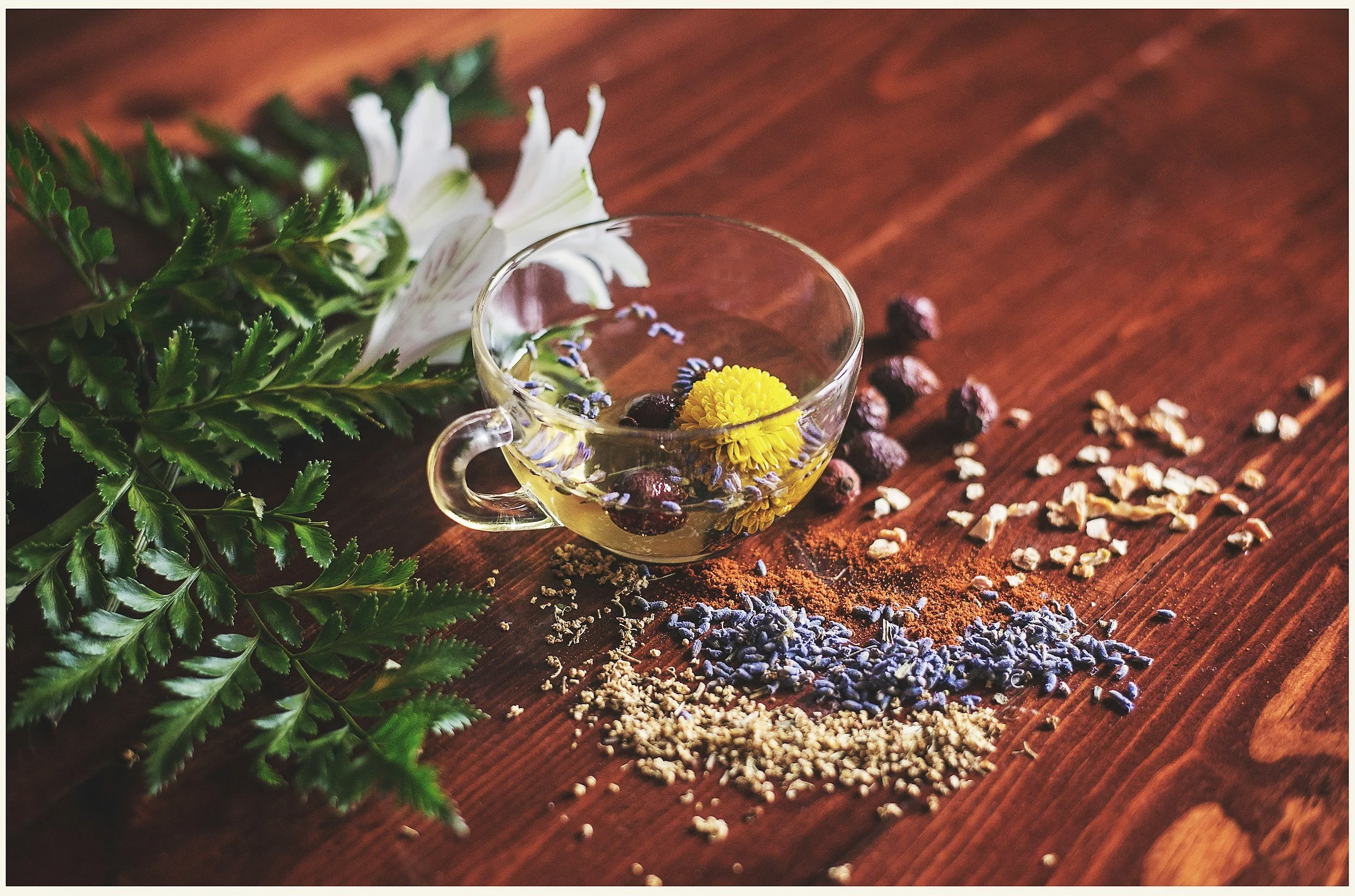
various herbs on a wooden surface and in a glass cup, used to signify customized herbal formulas at Stockheart Whole Health.
Yu Ping Feng San, Jade Windscreen Powder
Yu Ping Feng San is one of the classic formulas used when wei qi is weak. It is often considered for people who catch colds easily, sweat easily, feel sensitive to wind, or react strongly to seasonal shifts.
This formula is more about strengthening the defensive system than forcefully opening the nose. It is often used preventively or for milder to moderate patterns rooted in deficiency.
Cang Er Zi San
Cang Er Zi San is a classic formula used for nasal obstruction, sinus congestion, and blocked nasal passages. It is commonly considered when the head and face feel clogged and the main issue is obstruction rather than only sneezing or itching.
Xin Yi San or modified nasal-opening formulas
Magnolia flower, or Xin Yi Hua, appears in many formulas for nasal congestion and sinus obstruction. It is often used when the nose feels blocked and the sinuses need help opening.
Formulas for wind-heat
When symptoms look hot and inflamed, with red eyes, burning sinuses, sore throat, or yellow mucus, a practitioner may consider formulas that release wind and clear heat.
Formulas for dampness and phlegm
When symptoms are thick, heavy, foggy, and mucus-filled, a practitioner may focus on transforming dampness and phlegm while supporting digestion.
Herbs are powerful medicine. They should be chosen carefully, especially for people who are pregnant, taking prescriptions, managing blood pressure, using blood thinners, dealing with liver or kidney disease, or managing complex medical conditions. At Stockheart, we want herbal care to be thoughtful, safe, and matched to the person in front of us.

Woman eating delicious bowl of cooked grains, vegetables, and sweet potatoes, signifying the value of food therapy and care at Stockheart Whole Health.
Food therapy for allergy season
In Chinese medicine, food has temperature, direction, and energetic quality. That does not mean food is mystical. It means food affects how the body feels and functions.
During allergy season, food therapy often focuses on reducing dampness, supporting the Spleen, protecting the Lung system, and avoiding foods that increase mucus, heat, or inflammation for that person.
For damp, phlegm-heavy patterns, it may help to reduce:
Dairy
Refined sugar
Greasy or fried foods
Excess cold foods and iced drinks
Alcohol
Heavy, rich foods
Too many processed foods
For heat patterns, it may help to reduce:
Alcohol
Very spicy foods
Fried foods
Excess sugar
Greasy foods
Foods that clearly worsen redness, burning, or irritation
For weak Spleen and Lung patterns, it may help to emphasize:
Warm cooked foods
Soups and broths
Ginger in appropriate amounts
Congee
Steamed vegetables
Pears for Lung dryness
Mushrooms
Scallions in early wind-cold patterns
Simple, steady meals
For many allergy patients, warm fluids are more helpful than cold drinks. Warm tea, broth, and soups can support circulation, soothe the throat, and help mucus move.
Food does not cure seasonal allergies by itself. It changes the terrain. During a flare, that can be enough to make the season more manageable.

Simple home care through a TCM lens
Rinse the nose
Saline rinsing is simple, inexpensive, and often very effective. From a practical standpoint, it removes pollen and irritants from the nasal passages. From a TCM lens, it helps clear the local obstruction so the Lung system does not have to keep fighting through the same exposure.
Use sterile, distilled, or previously boiled water. Do not use tap water directly. During peak season, rinsing after outdoor exposure can make a noticeable difference.
Protect the neck and upper back from wind
In Chinese medicine, the back of the neck is considered an area where wind can enter the body. Scarves, collars, and simple wind protection are old-school for a reason. This is especially useful during spring weather swings, when one day feels warm and the next turns cold and damp.
Start support before peak season
Preventive care is very TCM. We do not need to wait until the body is overwhelmed. For many people, acupuncture and herbs work best when started before the worst symptoms arrive.
Keep the bedroom clean during pollen season
Wash bedding regularly. Keep windows closed on high pollen days. Shower or rinse hair after long outdoor exposure. Change clothes after yard work or long walks. This reduces the environmental load on the Lung system.
Support digestion
When digestion is weak, dampness and phlegm can build more easily. Warm meals, steady eating, less sugar, and less heavy dairy can reduce the internal load that makes congestion worse.
Sleep like it is part of the treatment
Poor sleep weakens resilience. In TCM terms, it can drain qi, disturb regulation, and make the body more reactive. Allergy patients often underestimate how much sleep loss intensifies symptoms.

Dr. Stephen Thompson doing a thorough intake to help this patient with allergies.
How Stockheart Whole Health can help
At Stockheart Whole Health, we look at seasonal allergies through a whole-person Chinese medicine lens. We are not only asking what you are allergic to. We are asking how your body is responding.
Are your symptoms windy and reactive?
Are they damp, heavy, and congested?
Are they hot, red, itchy, and inflamed?
Are they tied to weak wei qi and low resilience?
Are digestion, stress, sleep, or chronic depletion making the season harder?
Care may include acupuncture, Chinese herbal consultation, food therapy, seasonal planning, breathing support, nasal care, and practical changes that reduce your total exposure. For some people, chiropractic care, bodywork, or broader lifestyle support may also play a role, but the center of this approach is pattern-based Chinese medicine.
That means we do not treat every allergy patient the same way.
We listen. We assess. We look for the pattern. Then we build the plan around the person.
Related Posts
Treating Allergies Holistically: Root Causes, Real Relief
Why Are My Allergies So Bad?
Acupuncture for Whole-Person Wellness
Digestive Disorders and the Gut-Brain Connection
Everyday Habits for a Healthy Nervous System