
The Sacred Bone: A Whole-Person Guide to Caring for Your Sacrum
by Michele Renee, DC, MAc
STOCKHEART WHOLE HEALTH · THE BODY, WHOLE
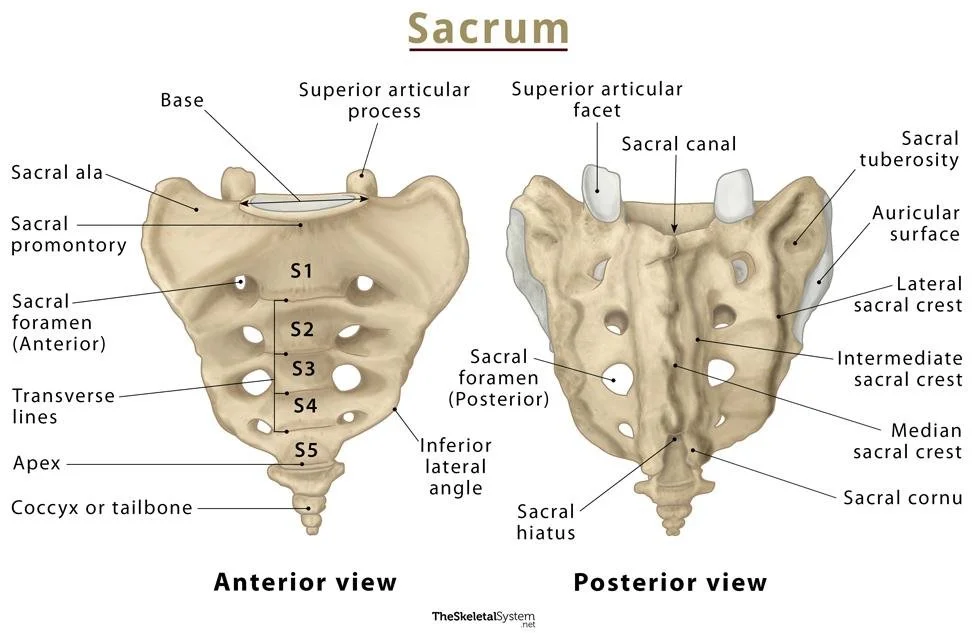
Diagram of the front and back of the sacrum with anatomy labeled. Thanks for the skeletalsystem.net for use of this image.
Deep at the base of your spine sits a bone the ancients named os sacrum: the sacred bone. Whether the name honored its role in birth, its place at the body’s center of gravity, or simply its quiet resilience, the sacrum has long been seen as more than a piece of the skeleton. At Stockheart, we think of it as your foundation: the keystone that carries your weight, steadies your movement, and links your spine to the ground beneath you. When it’s content, you rarely notice it. When it isn’t, it can influence everything from how you sit to how you sleep.
Let’s take a whole-person look at the sacrum and the sacroiliac (SI) joints: what they are, how they work, why they so often drive low-back, hip, and pelvic pain, and the gentle, integrative ways we help them heal at our Minneapolis practice.
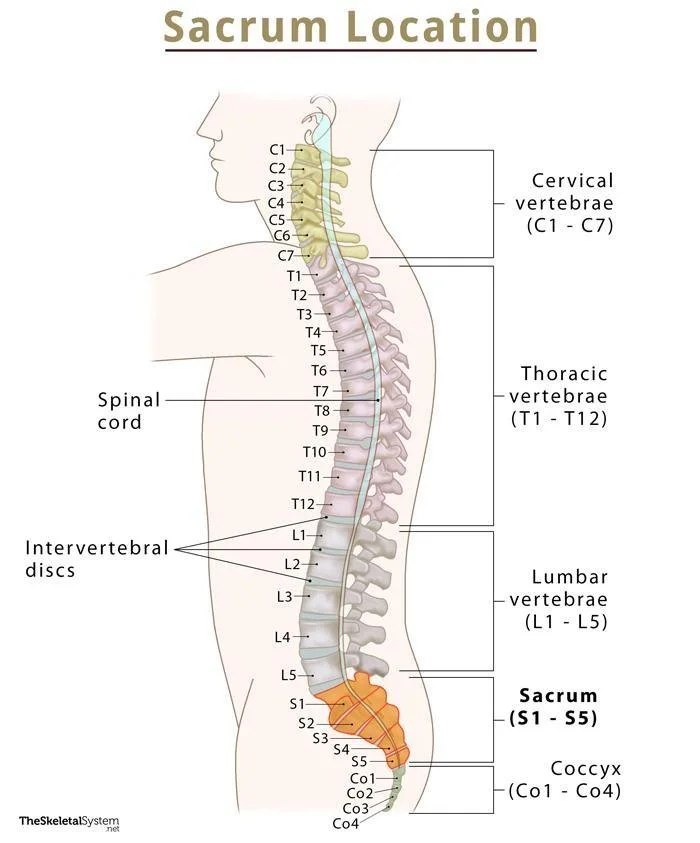
A full spine image providing context for where the sacrum is within the entirety of the spine. Thanks to theskeletalsystem.net for sharing this image with us.
Sacrum anatomy: a triangle at your center
The sacrum is a large, triangular bone at the base of the spine, formed from five vertebrae (S1–S5) that fuse together as we grow into adulthood. It sits elegantly like a wedge between the two large bones of the pelvis (the ilia), joining them at the sacroiliac (SI) joints on either side. Above, it meets the lowest lumbar vertebra (L5); below, it tapers into the coccyx, or tailbone.
Though it looks like one solid block, the sacrum is an engineering marvel:
The SI joints connect the sacrum to the pelvis on each side. They’re wrapped in some of the strongest ligaments in the body, built for stability rather than large motion.
The sacral canal runs down its center, carrying and protecting the sacral nerve roots, the same nerves that help govern the bladder, bowel, sexual function, and sensation and movement in the legs.
Four pairs of openings (foramina) let those nerves pass through to the front and back of the pelvis.
Muscle and fascia anchor here: the deep gluteals, the piriformis, the low-back muscles, the pelvic floor, and the broad sheet of thoracolumbar fascia all have a relationship with the sacrum.
All told, the sacrum is a busy crossroads: bone, joint, nerve, muscle, and fascia meeting in one place.
The keystone that carries you
Its shape is its job. Wedged between the pelvic bones, the sacrum acts as the keystone of the pelvic arch: with every step, the weight of your upper body passes down through the spine, into the sacrum, and out to the hips and legs. The more it’s loaded, the more securely it locks into place.
The sacrum isn’t rigid, though. It makes small, rhythmic rocking movements (nutation and counternutation) that are essential for walking, bending, deep breathing, and, notably, for childbirth, when subtle sacral motion helps the pelvic outlet open. It also serves as the anchor for the pelvic floor and a key player in core musculature stability.
There’s a subtler layer, too. The membranes surrounding the spinal cord attach at the sacrum and travel all the way up to the skull, which is why many body-based traditions describe a felt connection between the base of the spine and the head, the top and bottom of the bony nervous system. Whatever language we use, the message is the same: the sacrum sits at the literal and functional center of the body, and it never works in isolation.
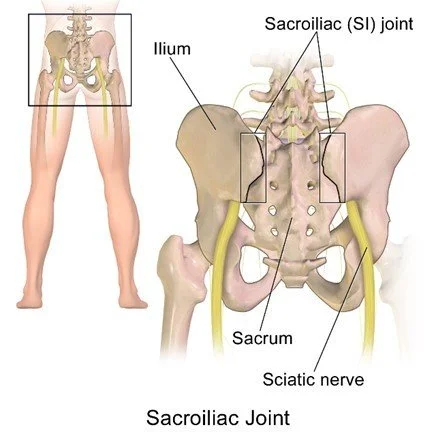
Image of the lower half of a human beside a drawing of a pelvis, lumbar spine, and femurs, as well as sciatic nerves. Thanks to spine-health.com for use of this image.
The sacroiliac joints and a pelvis out of balance
The sacrum doesn’t stand alone; it lives in partnership with the two halves of the pelvis, meeting them at the sacroiliac (SI) joints. These joints are unusual. They are built for stability more than motion, locked by dense ligaments and designed to transfer load, yet they still allow the small, essential glide that lets you walk, bend, and breathe with ease. Picture the sacrum and the two pelvic bones as a three-part arch: when each piece sits where it belongs, weight moves through smoothly and quietly.
When one part of that arch shifts and holds (what we often call a subluxated or misaligned pelvis), the whole structure has to compensate. A sacrum that rotates, or an SI joint that gets stuck, can tilt the pelvis, functionally lengthen one leg and shorten the other, and change how you load through your hips, knees, and feet. Muscles respond by guarding: the low back and glutes on one side work harder, the piriformis grips, the pelvic floor tightens. Over time that lopsided pattern travels: up into the low back and even the neck, or down into a hip or knee that “mysteriously” starts to ache.
A misaligned pelvis can also irritate the nerves passing through and around the sacrum. Because those nerves carry messages both to the legs and to the pelvic organs, an unhappy SI joint sometimes announces itself far from the joint itself, as sciatica-like leg pain or as the quieter organ-related signals we’ll come to shortly.
SI joints tend to respond well to gentle, specific care. Because they move so little to begin with, restoring their ease is usually a matter of precise, low-force encouragement rather than wrenching it into position.
Common sacrum and SI joint injuries
Because it’s a hub, trouble at the sacrum can show up in many ways. Some of the most common:
SI joint dysfunction. The most frequent culprit. When an SI joint moves too much or too little, it can create one-sided pain low in the back or deep in the buttock, sometimes wrapping into the hip or groin. It often flares with sitting, standing on one leg, rolling over in bed, or climbing stairs.
Ligament strain and pelvic imbalance. The sacrum’s strong ligaments can be overstretched by a fall, a twist, repetitive asymmetry (think always carrying a bag on one side), or a difference in leg length.
Piriformis and nerve irritation. The piriformis muscle attaches to the sacrum and lies right over the sciatic nerve. Sacral and pelvic imbalance can leave it guarding and gripping, contributing to buttock pain or sciatica-like symptoms down the leg.
Pregnancy and postpartum changes. Hormones soften the pelvic ligaments to prepare for birth, which is wise and necessary, and can also leave the SI joints feeling loose or achy before and after delivery.
Falls onto the tailbone. A hard landing on the sacrum or coccyx (an icy sidewalk, a missed stair, a sports spill) can bruise, sprain, or in some cases fracture the area.
Stress and insufficiency fractures. Distance runners and other athletes can develop sacral stress fractures from repetitive load; in people with lower bone density (including after menopause), even a minor fall can cause an insufficiency fracture.
Inflammatory conditions. Some forms of arthritis inflame the SI joints (sacroiliitis), causing stiffness and pain that’s often worst in the morning.
Sacrum and SI joint pain: what it feels like
Sacral and SI problems can be sneaky, because the pain often shows up somewhere other than the sacrum itself. These are the signals we hear about most:
One-sided low-back or buttock pain: often deep, dull, and hard to pinpoint, sometimes with a tender spot just inside the dimple above the buttock.
Pain that shifts with position: worse with long sitting, standing on one leg, getting in and out of a car, or rolling over in bed.
A catch, click, or “giving way”: a sense of the pelvis or hip slipping or grinding when you move.
Referred pain: into the hip, groin, or down the back of the thigh, sometimes mistaken for sciatica.
Morning stiffness: worst after rest and easing a little once you get moving.
A feeling of being “off”: one hip sitting higher, one leg feeling longer, or a gait that feels lopsided.
Tailbone tenderness: discomfort with prolonged sitting when the coccyx is involved.
If your pain is vague, migratory, or just won’t fit a tidy diagnosis, the sacrum and SI joints are worth a closer look. They’re frequently overlooked. And because the sacrum is a gateway for the nerves that serve your pelvic organs, its signals aren’t always about movement at all.
The subtle signals: your cycle and your digestion
This is where the sacrum’s whole-person nature really shows. The lower sacral nerves (roughly S2–S4) carry a large share of the body’s parasympathetic (“rest and restore”) signals to the pelvis, helping regulate the bladder, the bowel and rectum, and the reproductive organs. When the sacrum and pelvis are irritated, tense, or misaligned, that steady conversation between nerve and organ can get noisy.
For menstrual health, this can show up as:
Cramping and low-back pain that intensify around your period
A sense of pelvic heaviness, congestion, or dragging
Pelvic-floor tension that makes cramps feel sharper
For digestion, it can show up as:
Bloating, sluggishness, or constipation, especially when the low back and pelvis are tight
Discomfort that eases as the sacrum and surrounding muscles relax
To be clear: sacral tension isn’t the cause of every cramp or bout of bloating. Many things shape menstrual and digestive health, and persistent or severe symptoms always deserve a proper workup. But for many people, a pelvis stuck in a guarded, high-alert pattern quietly amplifies these symptoms. Calming the sacral area (easing the muscles, settling the nerves, restoring gentle motion to the pelvis) often helps the whole region feel more comfortable and more regulated. It’s one more reason we treat the sacrum as a hub for the whole pelvis.
A gentle red flag: when to seek medical care first
Most sacral pain is mechanical and responds well to gentle, conservative care. But because the sacrum houses nerves that serve the bladder, bowel, and pelvis, a few symptoms deserve prompt medical evaluation before bodywork:
New loss of bladder or bowel control, or numbness in the “saddle” area (inner thighs, groin, buttocks)
Progressive weakness or numbness in the legs
Severe pain after significant trauma, or any suspicion of fracture (especially with osteoporosis)
Fever, unexplained weight loss, or pain that’s worse at night and unrelieved by rest
If any of these are present, please seek medical attention right away. We’re always glad to help you find the right next step.
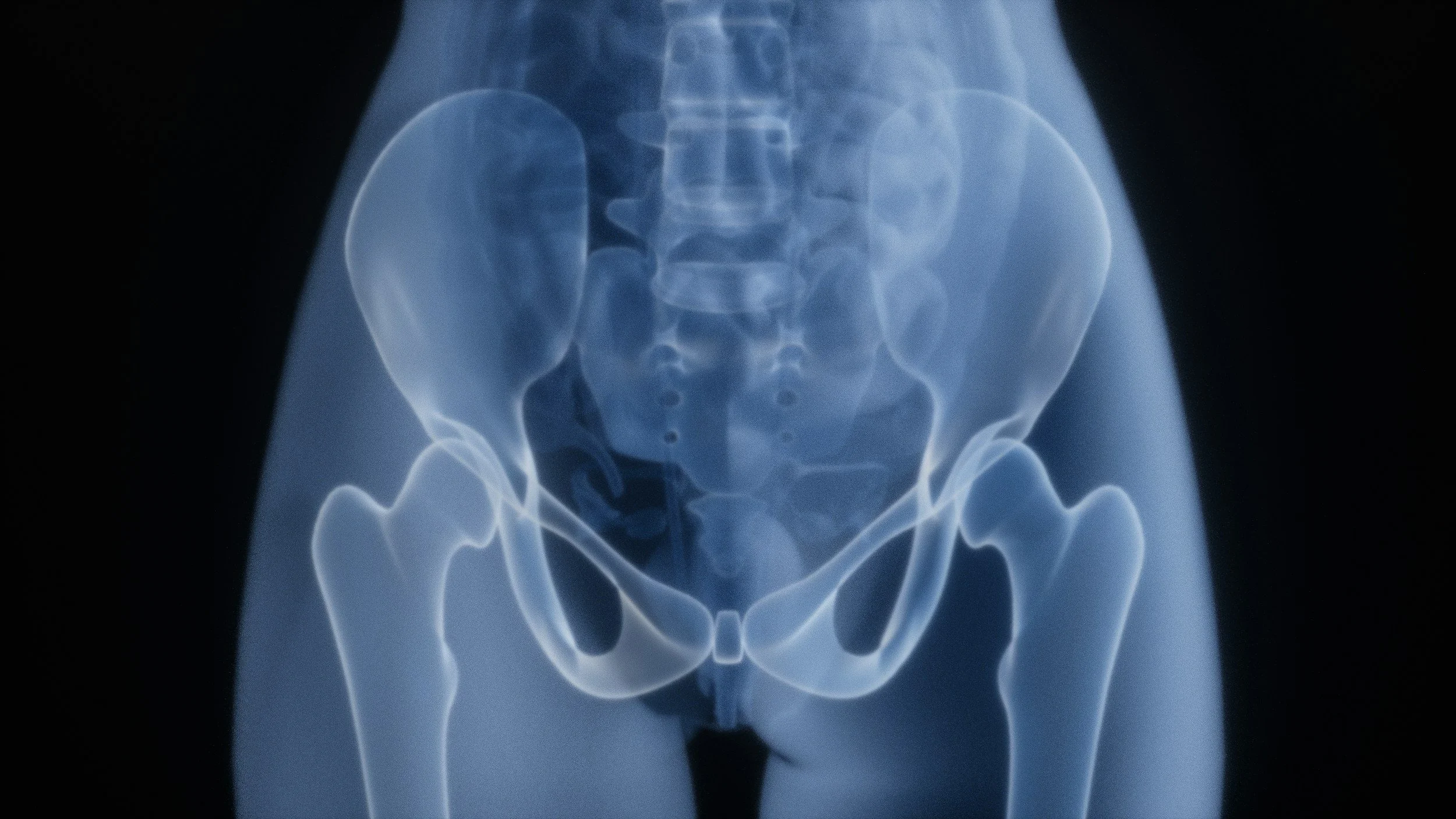
Anterior to posterior x-ray view of the pelvis
Trauma, stress, and the pelvis
The pelvis is one of the places the body tends to hold stress. When we feel threatened or unsafe, the nervous system braces, and some of that bracing settles low in the body: the pelvic floor grips, the hips tighten, the breath goes shallow. In the moment, this is protective and completely normal. When stress is ongoing, or when the body is still carrying older experiences it never had the chance to fully settle, that guarding can become a pattern the muscles hold long after the moment has passed.
Because the sacrum sits at the base of the spine and anchors the pelvic floor, it often carries this pattern. You might notice chronic low-back or pelvic tension, a pelvic floor that won’t relax, or discomfort that flares with stress and eases with rest and a sense of safety. None of this means something is broken. It is the body doing what it learned to do to keep you safe.
This is why we work the way we do. Trauma-informed care goes slowly and asks permission. It follows your pace, centers around you and your preferences, and pays attention to how your body is responding rather than pushing through. Gentle, unforced touch can help the nervous system feel safe enough to soften, and for many people that sense of safety is where things begin to shift. For some, bodywork sits alongside work with a therapist or other mental health support, and we are always glad to collaborate. What happens in your body is yours to direct.
Gentle, whole-person care for the sacrum
The sacrum and SI joints respond well to patient, low-force care that works with the nervous system instead of overriding it. At Stockheart, our whole-health clinic in Minneapolis, we often weave several approaches together, following what your body needs on a given day.
Gentle chiropractic
You don’t need to be twisted or cracked to find relief. Gentle, low-force chiropractic uses careful assessment and light, specific techniques, such as slow mobilization, drop-table work, pelvic blocking, and instrument-assisted adjustments, to restore ease and symmetry to the SI joints and pelvis. By addressing torsion, alignment, and the way you load through your hips and low back, we calm nerve irritation and give the joint room to move well again. The work is precise and low-force by design.
Acupuncture
The sacrum is rich territory in Chinese medicine. Classic points sit directly over the sacral foramina, known as the baliao (pronounced “bah-lee-OW”), or “eight seams.” These points have been used for centuries for low-back, pelvic, menstrual, and urinary complaints. In modern terms, acupuncture helps by modulating pain signals, quieting muscle guarding, and improving local circulation. It pairs especially well with sacral and SI issues that arrive bundled with pelvic tension, menstrual pain, or a nervous system stuck on high alert.
Massage and bodywork
Soft tissue is often where sacral pain lives. Skilled massage releases the gluteals, piriformis, low-back muscles, and the fascia that pull on the sacrum, easing the guarding patterns that keep pain going. Just as importantly, thoughtful, trauma-informed touch helps calm the nervous system, easing you out of bracing and toward rest. Gentle approaches like myofascial release and positional release can be especially soothing for a sensitive sacrum.
Craniosacral therapy
The intention of craniosacral therapy is to work with the membranes that run from the skull down to the sacrum, the same connective layer described earlier. Using very light contact, often no more than the weight of a nickel, the practitioner senses the subtle tension held in the tissues around the spine and sacrum and invites it to soften. For the sacrum, that can mean easing the pull where those deep membranes anchor, settling an overworked nervous system, and giving the pelvis room to let go. Because the touch is so light, craniosacral work often suits people who are in significant pain, feel fragile, or find that stronger bodywork puts them on guard. Many leave a session feeling calmer and more at home in their body.
Why we combine them
Because the sacrum is a crossroads of bone, joint, nerve, and fascia, no single approach owns the whole picture. Chiropractic restores joint mechanics, acupuncture modulates pain and tension, massage releases soft tissue, and craniosacral work helps the whole system settle. Woven together and paced to your comfort, they do more than chase symptoms. They help your foundation feel steady, supported, and safe again.
Your sacrum has carried you faithfully through every step of your life. It deserves care that’s just as grounded.
Ready to feel more grounded? If your low back, hips, or pelvis have been asking for attention, we’d be honored to help. Reach out to schedule a visit at Stockheart Whole Health in Minneapolis, your home for heart-centered, whole-person healing.

Stockheart Whole Health word mark
This article is for education and is not a substitute for individualized medical care. If you’re in pain or unsure what’s going on, please reach out. We’ll help you find the right path forward.