
What's Driving Your Migraines: The Nine Systems Nobody Investigated Together
By Dr. Brenna Erickson, DC
READ TIME: 11 MINUTES Part 2 of 3 — Part 1: What's Actually Happening in Your Brain | Part 3: What Migraine Care Can Actually Look Like
If you read Part 1, you learned that migraine is a threshold disorder — that your nervous system has a container, and when that container gets too full, it tips into an attack. You know that the threshold isn't fixed, that it moves based on conditions, and that the more powerful strategy isn't avoiding triggers one by one but systematically lowering what's filling the container.
This is that post.

snow capped craggy mountains are framed in purple and pink dawn light.
One thing worth saying before we get into it: if you look at this list and feel overwhelmed, that's a completely reasonable response. This is a lot of ground to cover. But this list is not a to-do list. You do not need to address all of these things.
This is not a to-do list. You do not need to address all of these things. You are not expected to have addressed all of these things. This is a map — a way of understanding the terrain so that when we talk about your specific picture, you have context for why certain things get prioritized and others don't. For most patients, two or three of these are the primary drivers. The work is identifying which ones, and addressing them in an order that makes sense.
So read this as a map, not an assignment. That’s what I am here to help with.
What's Actually Filling Your Container
Sleep is the foundation everything else is built on — and for a lot of my patients, it's also the thing that feels most out of reach. The hypothalamus, the same structure initiating your migraine cascade, also governs your circadian rhythm. Sleep deprivation directly lowers migraine threshold. It disrupts your brain's overnight cleaning process — the mechanism that clears inflammatory waste while you rest. It elevates cortisol, destabilizes blood sugar overnight, and quietly degrades every other system on this list.
Morning migraines often do have a sleep component — blood sugar drops overnight and cortisol patterns shift in the early hours, both of which can initiate a cascade before you've opened your eyes.
Weekend migraines and let-down attacks, the ones that arrive the moment you finally exhale after a hard stretch, are a different story. During sustained stress, cortisol stays elevated — and cortisol is transiently anti-inflammatory, which artificially props up your threshold to higher than it would otherwise be. When the stressor resolves and cortisol drops, the threshold falls with it, and the attack that couldn't get through during the week finally can. This is why people get migraines on the first day of vacation, the morning after a major deadline, the Saturday after a brutal work week. The sleep change that often accompanies weekends is downstream of this cortisol shift, not the primary driver. The real target is the magnitude of the cortisol fluctuation across the week — which points back to chronic stress load and overall allostatic burden.
What I'm looking for isn't just whether you're getting enough hours. It's the quality, the timing, and what's upstream of why it's broken — because fixing the surface without addressing what's driving it is just another thing that works for a while and then stops.

A young asian woman with long wavy hair raises her arms overhead while sitting in a bed with rump[led white sheets are morning light washes over her in a neutral cream apartment.
Hormone balance influences everything quietly, and it's one of the places where the story is often happening long before anyone thinks to look. If you menstruate and have migraines, you already know your cycle and your attacks are in conversation. But this runs deeper than just menstrual migraines. Estrogen has significant anti-inflammatory and neuroprotective effects. Progesterone has a calming effect on the nervous system, it literally helps your brain settle, and it supports sleep quality and emotional regulation. What often gets missed: chronic stress and burnout actively deplete progesterone. When your body has been running on cortisol for months or years, as so many of my patients have been long before they ever found my door, progesterone takes the hit. The nervous system loses one of its most important stabilizers. Add chemical estrogen exposure from plastics and personal care products, or the wild hormonal fluctuations of perimenopause, and you have a hormonal environment that a sensitized hypothalamus will feel immediately.

a woman with visibly graying hair is seen from above as she sits on patchy grass in lotus position
Blood sugar doesn't get enough credit as a migraine driver, and it's one of the most fixable pieces once you understand the mechanism. The brain runs on glucose. When blood sugar dips — even mildly — the brain perceives metabolic threat. For a migraine-prone brain, that signal can be enough to initiate a cascade. This is why skipping meals is such a reliable trigger, why attacks cluster in the late afternoon, why the "hunger headache" is a recognized phenomenon. It's also why eating well is so much harder when you're managing a chronic condition — migraines disrupt appetite and meal timing, which destabilizes blood sugar, which lowers threshold, which generates more migraines. Ensuring that blood sugar stays stable throughout the day is a simple way to raise your migraine threshold.

a white plate hold a meal of roast veggies topped with a oven roasted chicken thigh and side of french fries plated in a minimalist fashion.
Hydration is connected to blood sugar in the way it affects the brain's moment-to-moment stability. Dehydration is one of the most consistent migraine triggers, and it's not simply about drinking enough water. Cellular hydration requires electrolyte balance, sodium, potassium, and magnesium working together to move water across cell membranes. Drinking large volumes of plain water without adequate electrolytes can actually worsen cellular hydration. This is why some patients notice a meaningful difference when they add a quality electrolyte source, particularly one with magnesium, even when they thought they were already drinking plenty.

a woman sits on a bench by the ocean with a cheerful blue, red, and yellow glass water bottle with a bamboo cap sits next to her. We can see her holding an ice cream cone, wearing light blue jeans, an oversize button up shirt with wide blue and white stripes. Her should length brown hair is just visible to us, but her face is out of frame.
Caffeine works in both directions, and understanding the mechanism clearly changes how you use it. Caffeine is a vasoconstrictor, that's why it's an active ingredient in some migraine medications and why a cup of coffee can stop an early attack. The problem is what happens with regular use over time. Caffeine changes the brain's sensitivity, meaning when it wears off, the rebound effect becomes more pronounced and withdrawal becomes a reliable trigger in its own right. For frequent migraine sufferers, caffeine dependency quietly lowers the threshold over time. This doesn't mean everyone needs to eliminate it completely; it means understanding the mechanism so you can use it strategically rather than reactively.

seen from above three hands hold 2 lattes and an iced coffee together a wooden table is blurry underneath
Gut health and food sensitivities matter because the gut and brain are in constant two-way communication, and for many of my patients, the gut is quietly running hot long before anyone connects it to their migraines. When the gut microbiome is out of balance, the result is systemic inflammation that the brain feels directly. Food sensitivities operate on a similar pathway. Worth being specific here: this is not the elimination diet you've already tried, the one that was exhausting to maintain and helped until it didn't. Food sensitivities are delayed inflammatory responses, occurring 24 to 72 hours after exposure, which makes them nearly impossible to identify from a food diary alone. Common culprits in migraine include gluten, dairy, eggs, artificial sweeteners, and MSG, but the list is individual, and identifying yours requires more than willpower and a spreadsheet. This is a process that I work with my patients 1-1 on.
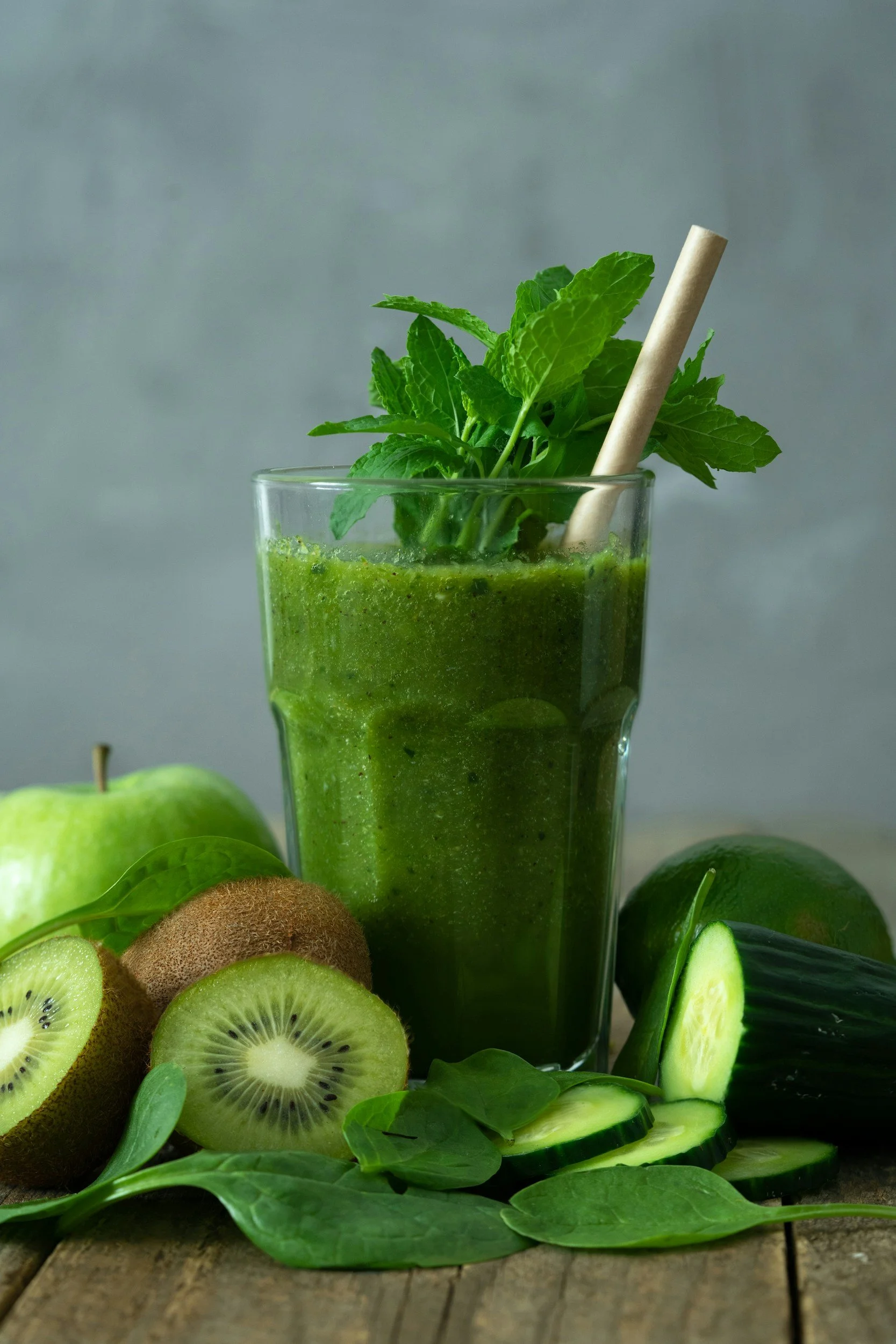
a green smoothie fills a clear glass with a staw and spring of mint garnish. the raw ingredients surround the glass including kiwis, cucumbers, spinach, and green apple.
Histamine intolerance gets missed constantly, and I bring it up often with patients who feel like their food reactions make no sense. Histamine is found in aged, fermented, and leftover foods — wine, aged cheeses, cured meats, vinegar, kombucha, smoked fish. In a healthy gut, an enzyme called DAO breaks it down before it accumulates. In a gut that's out of balance, DAO production is impaired, and histamine accumulates. Histamine causes blood vessels to dilate and directly irritates the trigeminal nerve system at the center of the migraine cascade. The part that makes this so hard to catch: it's not one food — it's accumulation. A glass of wine plus leftover chicken plus a stressful week plus the wrong day in your cycle. Any one of those alone might be fine. Together, they tip the bucket over. No food diary will show you that pattern.
Toxic burden is a topic I approach carefully, because it's easy for this conversation to feel overwhelming or shaming — and that's the opposite of what I'm going for. The grounded version: your liver, kidneys, and lymphatic system are continuously processing the environmental compounds you're exposed to every day. Those systems have a capacity. When ongoing input exceeds that capacity, burden accumulates — and a body carrying a high toxic load runs a more inflamed, more reactive, lower-threshold nervous system. The most important first step isn't a cleanse. It's reducing what's coming in. Synthetic fragrance in personal care and household products is one of the most significant and underappreciated daily sources. Plastics, conventional produce, mold in the home environment — all worth a thoughtful look. This doesn't have to be all-or-nothing. Small, consistent reductions give your body's systems the room they need to do what they're already designed to do.

a shop perfume display on a round wooden table, a ring for rectangular glass bottles with black dropper caps, and natural dark gray stones ring the table.
Mitochondrial function is the energy story nobody tells migraine patients, and it's the one that often explains the exhaustion that goes so far beyond what the migraines themselves should account for. Research shows that the migraine nervous system has impaired energy production at the cellular level, not just during attacks but between them. If you've ever described your fatigue as bone-tired, the kind that doesn't resolve with rest and feels different from ordinary tiredness, this is part of what you're describing. This is part of why magnesium, CoQ10, and riboflavin (B2) have the evidence base they do in migraine prevention. All three are directly involved in how cells produce energy, and deficiencies in all three are common in migraine patients. Cellular energy is downstream of everything else on this list. Inflammation, blood sugar instability, poor sleep, toxic burden all impair it.
A Note on Feeling Overwhelmed
If you've just read through nine contributors and feel like this is too much, that's worth naming directly.
This is a long list. And yes, for some people, several of these are active simultaneously. That can feel like a lot to sit with.
But the fact that there are this many possible contributors is good news. It means there are many possible levers. It means there are likely things in your picture that have never been investigated, let alone addressed. It means the story isn't over, we are just getting started.
You don't address all of this at once. You assess, you prioritize, you work in order. The goal isn't perfection across nine systems — it's identifying the two or three that are driving the most load in your specific body and making meaningful progress there.
That's the work. And it's very doable.
What's Next
Part 3 describes what it looks like to address all of this together, the modalities, the approach, and what care at Stockheart looks like in practice.
If you're ready to talk about your picture now rather than waiting for Part 3, a consultation is a good place to start. It's a conversation. We look at your history, your pattern, your labs, your life, and you leave with a much clearer sense of what's driving your migraines and what it would take to change it.
There's no obligation beyond the conversation. And for most people, just having the picture mapped is itself meaningful.
→ Request a consultation at Stockheart
Not ready yet? The Oh Sheet Migraine Emergency Kit is always free, always available, and a real place to start while you're figuring out next steps.
Stockheart Whole Health is an integrative clinic in Minneapolis offering chiropractic, acupuncture, massage therapy, and nutritional support. We specialize in whole-person care for people navigating complex, whole-body transitions.

Brenna Erickson DC
Dr. Brenna Erickson practices at Stockheart Whole Health in Minneapolis, offering chiropractic care, DNFT, cranial adjusting, and functional medicine for people with chronic and complex migraine. Stockheart's integrative team also includes acupuncture and massage therapy. To explore care, request a consultation here.
